












Dishwasher not draining? Why there's water in the bottom and how to fix it
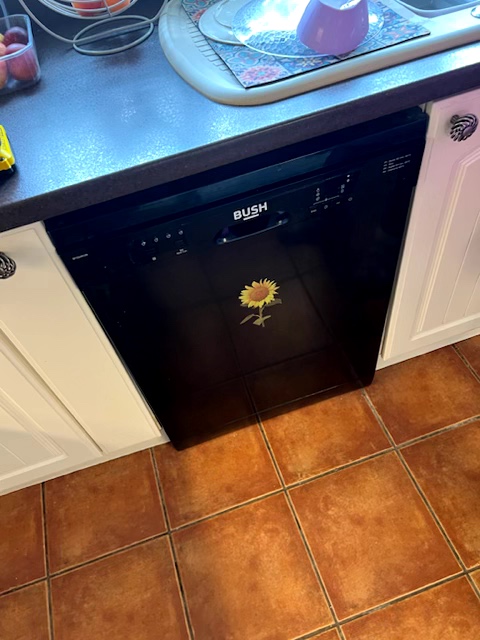
A pool of dirty water in the bottom of the dishwasher after a cycle means it isn't draining. We attended 656 dishwashers that weren't draining in the last 12 months. A good few turn out to be a blocked filter, which is a ten-minute job, so here are the checks worth doing before you book anyone.
Safe checks you can do first
Turn the dishwasher off at the wall, and get towels and a shallow container ready, because you'll be lifting water out.
Scoop the standing water out with a cup, then a sponge for the last of it, until you can see the base. Now take the filter out. It's the round plastic piece in the bottom, usually a twist to unlock. Under it, in the sump, is where food, glass and the odd label collect. Rinse the filter under the tap and clear anything left in the sump below it. Our guide on cleaning the dishwasher filter goes through it properly.
Check the drain hose next. It runs from the back of the machine to the waste under the sink, and it kinks easily where the machine's been shoved back into its gap. Follow it and make sure nothing's crushed or bent sharp.
Last, look at where it drains into. Most dishwashers empty into a spigot on the sink waste or trap. If that's blocked, or a newly fitted machine still has the blanking cap on the spigot, the water has nowhere to go. Pour some water down the sink and check it runs away.
Run a short cycle once you've done all that. If the water clears, you're sorted.
When it's a repair
Filter clean, hose clear, waste running away, and still a puddle in the bottom. Now the fault's inside the machine. The drain pump is the usual answer, and it's one of the parts we replace most on dishwashers. It either fails silently or hums but shifts no water, and either way the cycle stops before it drains. A blocked pump does the same, when something small gets past the filter and jams the impeller. There's the electrical side too. A pressure sensor that wrongly reads the machine as empty, or a control fault, both show up as a machine that won't drain. That's the point to get an engineer out, since it means working on a mains appliance sitting in water.
What a repair costs
Going on our own jobs, customers typically paid £104 to £175 in total for this repair, including parts and VAT (from 435 repairs). You'll have a fixed price before any work starts. Our engineers carry common parts on the van, so many repairs are finished at the first visit.
Book a dishwasher repair
If you've cleared the filter and hose and there's still water in the bottom, book a dishwasher repair or find your local dishwasher engineer.
Frequently asked questions
Why is there water in the bottom of my dishwasher?
Usually a blockage in the filter, sump, drain hose or the sink waste it drains into. When it isn't a blockage, the drain pump is the most likely cause, though a faulty pressure sensor or control fault look the same from outside.
How do I drain a dishwasher that's full of water?
Scoop and sponge the standing water out, take out the filter, and clear the sump underneath. Then check the drain hose isn't kinked and the sink waste runs freely.
Can I fix a dishwasher that won't drain myself?
Often, yes. Clearing the filter, sump and drain hose is a reasonable job. Opening the machine up to reach the pump isn't, and neither is anything electrical.
How much does it cost to fix?
Customers typically paid £104 to £175 in total for this fault, including parts and VAT (from 435 repairs). We confirm a fixed price before any work starts.
What our engineers found on 656 jobs
The figures below come from NAC's own repair records: 656 dishwasher jobs our engineers attended for this fault, what they found, what fixed it and what it typically cost.
When a dishwasher stops draining, the cause found most often is a blocked drain pump. Bits of broken glass, food waste, grime and small objects such as rubber seals or splinters of wood can get into the pump and stop it from turning, so the water just sits in the bottom of the machine. The next most common cause is a drain pump that has failed altogether and no longer works even when it is clear. Less often, the trouble lies further along, with a drain hose or waste pipe that has become clogged so the water has nowhere to go.
An engineer will usually start by removing the standing water, then check whether the pump turns freely and clear out anything caught in it. If the pump is clear but still not working properly, or is slow and noisy, they will test it and replace it if it has failed. A new pump often has to be ordered and fitted at a second visit. The engineer will also check the hose and waste pipe and clear any blockage they find.
Once the repair is done, the dishwasher is run on a cycle to make sure it drains properly and works as it should.
Written by our engineers from these jobs.
- Jobs attended
- 656
- Confirmed repairs
- 443
- This is not a success rate. Jobs inside their 60-day window, jobs still being classified, jobs held for review and visits that didn't end in a repair aren't counted.
- Fixed at the first appointment
- 66%
- about 2 in 3 of our repairs
- Typical total paid by customers
- £104 to £175
- including parts and VAT, from 435 repairs
What's usually behind it
The causes our engineers found and fixed, as a share of our 443 confirmed repairs for this fault.
-
Blocked drain pump: about 2 in 5 of our repairs, from 163 jobs.
37% -
Failed drain pump: about 1 in 5 of our repairs, from 87 jobs.
20% -
Blocked drain hose or waste pipe: about 1 in 6 of our repairs, from 72 jobs.
16%
We only list causes with enough repairs behind them, so the shares won't add up to 100%.
Error codes we see with this fault
- AEG I11: Water fill or water level fault, often pressure switch or pressure chamber related.
- Blomberg E01: Anti-flood protection activated: water detected in the base.
- Bosch E23: Drain pump fault: the appliance is not draining.
- Bosch E24: Drain fault: the appliance cannot empty.
- Bosch E25: Drain fault, often a blocked drain pump or pump cover.
- Caple E4: Anti-flood protection: internal leak or water detected in the base.
- CDA F2: Drain fault.
- Grundig E01: Drain fault.
- Hisense F12: Water inlet or fill fault.
- Hotpoint E15: Anti-flood sensor triggered: water in the base.
- Lamona E01: Anti-flood protection activated: water detected in the base.
- Miele F11: Drain fault: the appliance is not draining.
- Miele F70: Anti-flood protection activated: water detected in the base.
- Neff E24: Drain fault: drain blocked or pump not working.
- Neff E25: Drain fault, often a blocked drain pump; also seen with water in the base.
- Prima E4: Leak detected in the base.
By brand
Brands with enough repairs of their own for this fault to show separately.
Bosch dishwasher not draining
160 jobs, 116 confirmed repairs. Customers typically paid £104 to £167 (from 115 repairs). 68% fixed at the first appointment.
This is not a success rate. Jobs inside their 60-day window, jobs still being classified, jobs held for review and visits that didn't end in a repair aren't counted.
- Blocked drain pump 36%about 1 in 3 of repairs, from 42 jobs
- Blocked drain hose or waste pipe 25%about 1 in 4 of repairs, from 29 jobs
- Failed drain pump 23%about 1 in 4 of repairs, from 27 jobs
Neff dishwasher not draining
62 jobs, 44 confirmed repairs. Customers typically paid £104 to £185 (from 44 repairs). 36% fixed at the first appointment.
This is not a success rate. Jobs inside their 60-day window, jobs still being classified, jobs held for review and visits that didn't end in a repair aren't counted.
No single cause has enough repairs behind it yet to show for Neff.
Miele dishwasher not draining
58 jobs, 37 confirmed repairs. Customers typically paid £110 to £210 (from 37 repairs). 57% fixed at the first appointment.
This is not a success rate. Jobs inside their 60-day window, jobs still being classified, jobs held for review and visits that didn't end in a repair aren't counted.
No single cause has enough repairs behind it yet to show for Miele.
AEG dishwasher not draining
44 jobs, 35 confirmed repairs. Customers typically paid £104 to £152 (from 33 repairs). 66% fixed at the first appointment.
This is not a success rate. Jobs inside their 60-day window, jobs still being classified, jobs held for review and visits that didn't end in a repair aren't counted.
No single cause has enough repairs behind it yet to show for AEG.
Why the first-appointment figure differs by brand. Our engineers carry common parts on the van, so those repairs can be finished at the first appointment. Other parts have to be ordered in, and fitting them takes a second visit.
About the price. £104 to £175 is the typical total paid by customers, including parts and VAT: the middle half of what customers paid on 435 of these repairs. Repairs paid for by manufacturers and insurers aren't counted, because that work is charged at contract rates. It's a guide, not a quote. Your engineer confirms a fixed price before any work starts.
- Dishwasher repair
- Dishwashers
- Not draining
- Drain pump
- Filter
Rather leave it to us?
- Fixed-price quote before any work starts
- Same or next-day visits where available
- UK-wide engineer coverage